
FAQ about aviation training
from the book Learn Before Flight

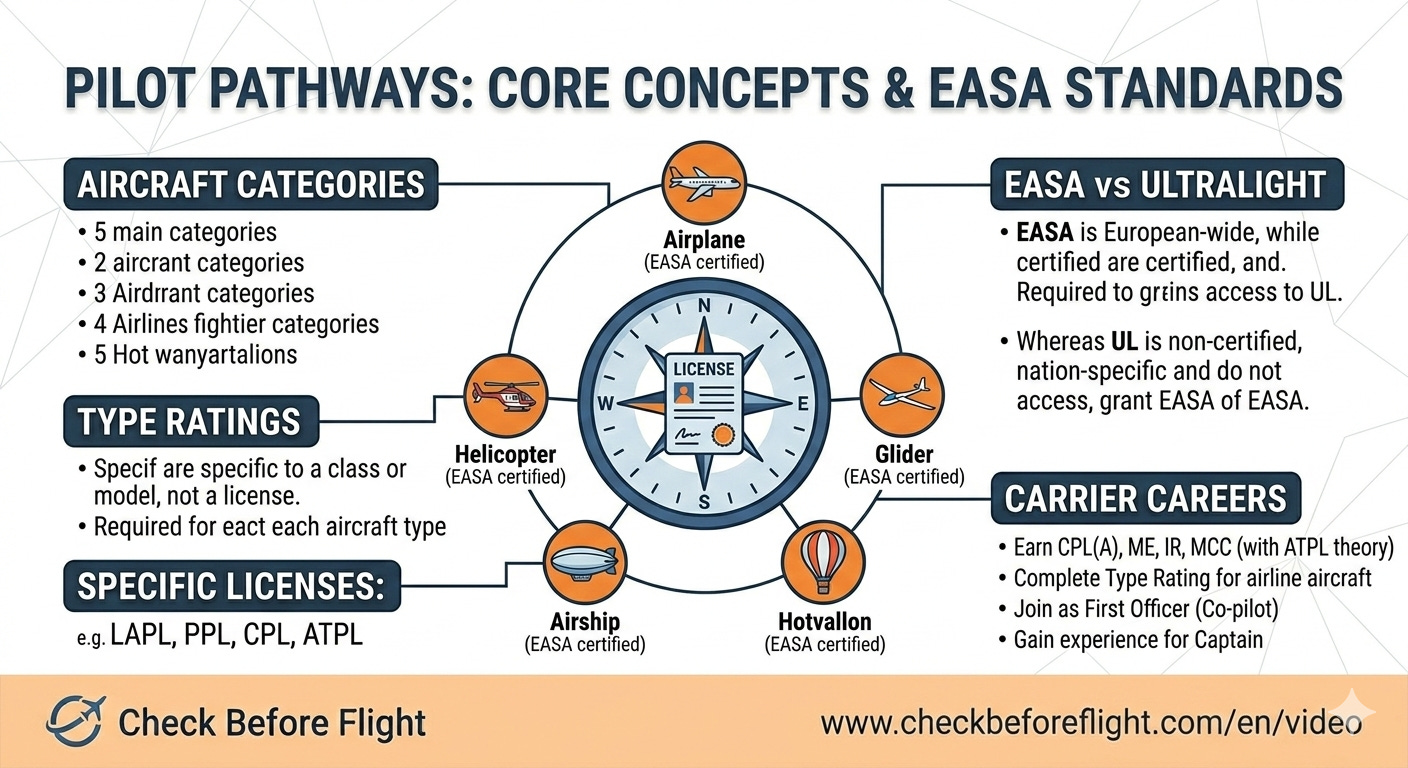
The world of aviation is as fascinating as it is complex. To enter it, you need to know the basics, learn the language, and understand the differences between aircraft categories, license types, training paths, and careers.
In this article, we present an excerpt from the book Learn Before Flight, written by the founders of the Check Before Flight platform. These are the FAQs that Eleonora and Luca answered as a preliminary guide before diving deep into every topic in their book and in the video tutorials available on our website (both in italian and english): www.checkbeforeflight.com/en/video.
1. At what age can I start pilot training?
There is actually no minimum age to start. During a Private Pilot License (PPL) course, part of the training involves flying without an instructor on board (known as “solo” or “single-pilot” activity). To fly solo, you must be at least 16 years old, while the minimum age for the final exam is 17. Since a course typically lasts between 8 and 18 months, you can ideally start just before turning 16. For professional courses, however, you must be at least 18.
2. Can I become a pilot if I wear glasses?
Yes, civil pilots can use corrective lenses. There are diopter limits per eye, but you can find the specific parameters in the EASA Part MED regulations online.
3. Do I need to know English well to work as a pilot?
English is fundamental. The courses, exams, flight manuals, and regulations are all in English. By definition, this job involves crossing national borders, so it is essential to know the world’s common language. Both airplane pilots and those in other aircraft categories must pass a specific exam called the “Language Proficiency Check” to become professional pilots and fly abroad. In any case, if you start traveling the world, knowing another language never hurts.
4. How do I become an airline pilot?
An airline pilot begins their career by obtaining a Commercial Pilot License (CPL), along with Instrument Rating (IR), Multi-Engine (ME) rating, and Multi-Crew Cooperation (MCC) training. Afterward, they must obtain a Type Rating for the specific aircraft model used by the airline they wish to join. Many recruitment programs exist where airlines select potential pilots before, during, or after they earn their official license. You start as a First Officer (co-pilot) and can eventually aim to become a Captain.
5. How do I become an air ambulance (HEMS) pilot?
A HEMS (Helicopter Emergency Medical Services) pilot starts by obtaining a Commercial Helicopter Pilot License. To become a HEMS crew member, you first need to gain some work experience. Working for aerial work companies or passenger transport firms is a crucial step before applying to be a HEMS co-pilot. To become a Captain, significant experience as a rescue pilot (if you entered as a co-pilot), firefighting pilot, or in sling-load operations is required.
6. Do I need a high school diploma to get a license?
No specific educational degree is required to obtain a flight license, whether for private use (LAPL and PPL) or professional use (CPL and ATPL). Even to become a Captain on a Boeing 747 for intercontinental flights, you don’t technically need a high school diploma. This is because EASA regulations are European-wide, and it would have been difficult to define a “diploma” identically for every country. Ultimately, if you pass the flight courses, your competence is confirmed by the issuance of the license.
7. How do I become an aircraft mechanic?
To become a certified technician, you must attend theoretical courses at specialized schools, pass the relevant exams with the aviation authority, and then secure an apprenticeship for the practical O.J.T. (On-the-Job Training) required for the final practical exam and license issuance. We have included a dedicated chapter for this profession in the book.
8. With an airplane pilot license, can I also fly a helicopter?
Each aircraft category (airplanes, helicopters, gliders, airships, hot air balloons) has its own specific license. However, if you want to switch to another category, you can claim credits to follow a reduced training path.
9. How long does a Private Pilot License (PPL) course last?
The course takes between 8 and 18 months, considering the time needed for 100 hours of ground school, the theoretical exam, 45 flight hours, and the final practical checkride. Anyone telling you it takes only 4 months is selling you a myth. While there is no maximum time limit, we recommend not stretching it out too much. Think of when you learned to drive: if you only drove 10 kilometers every two months, you wouldn’t have learned much, and they’d have to explain how to start the car every single time.
10. How long does it take to become a professional pilot?
In an Integrated Course, the limit to finish is 24 to 36 months (depending on the program). With a Modular Path, regulations do not impose a time limit, so it could take 10 years depending on your schedule. However, if you complete all steps continuously, this path can also take just under 3 years.
11. How much do professional airplane pilot courses cost?
That’s the “million-dollar question.” It depends heavily on the aircraft used and the ratings you seek. If you want to train on a Cirrus and get a Boeing 737 Type Rating, it will cost over €100,000. If you do the entire path on a Tecnam P2006 and get an IR on a piston multi-engine, it will cost between €60,000 and €80,000.
12. How much do professional helicopter pilot courses cost?
It depends on the ratings. An instrument rating (IR) on a twin-engine turbine machine (like those used in HEMS) will cost over €100,000. If you stick to VFR (Visual Flight Rules) with ratings for a Robinson or Guimbal, it will cost between €70,000 and €90,000.
13. How much does a pilot earn?
This is the hardest question because there are so many variables. It depends on whether you fly airplanes or helicopters. Airplane pilots might have a higher starting salary, while helicopter pilots often have a longer “apprenticeship” period. You also have to consider the aircraft type, your ratings, the type of operations, and the country you work in. Unfortunately, we cannot provide a single fixed number.
14. Can I fly abroad?
To cross the borders of the country where you got your license, you must pass the English radiotelephony exam and the Language Proficiency Check (LPC).
15. I’d like to fly firefighting planes.
Firefighting is a very specialized activity requiring above-average flying skills. To join these crews, you need a Commercial Pilot License and a minimum amount of flight experience as required by each specific company.
16. Can I work with a Private Pilot License?
A Private Pilot License only allows for non-profit flight activities. To be hired by a company as a pilot, you need a professional license (CPL/ATPL).
17. What is the difference between Integrated and Modular courses?
If you’re asking this, you already know a bit about aviation. Modular courses lead to a professional license through step-by-step training: PPL first, then hour building, then professional theory exams, and finally the CPL module. This grants you intermediate titles recognized across Europe. An Integrated course is a continuous program at one school that takes you to the final exam within a set timeframe without intermediate licenses. Both have pros and cons, which are explained in detail in the manual.
18. What kind of aircraft can I fly once I get my license?
You can fly the aircraft for which you obtained a rating during your course. Unlike driving—where learning on a Golf allows you to drive a Mercedes—every aircraft requires a specific Class or Type Rating.
19. How do I compare quotes from different flight schools?
This is difficult because while training paths are standardized (certified), every school uses different aircraft, has different hourly rates, uses different simulators, or operates within aero clubs. We suggest reading this book first to “open your eyes,” then contacting us at www.checkbeforeflight.com if you need further clarification.
20. Can I fly airliners with a CPL?
Another advanced question! If you know what a CPL is, you’re off to a good start. To become a co-pilot for an airline, you need a CPL with an Instrument Rating (IR), Multi-Engine (ME) rating, and an MCC course (along with ATPL theory). Then you’ll get a Type Rating for the specific model and be ready for hire.
21. If I get my license in Italy, can I fly throughout Europe?
Licenses obtained under EASA regulations (in any EU country plus some neighboring standardized countries) allow you to fly aircraft registered in any EASA member state. To fly outside of Italy, you simply need the English radiotelephony rating and the Language Proficiency Check mentioned earlier.
22. Is a license obtained in the USA valid in Europe?
The USA is not an EASA country; they follow FAA (Federal Aviation Administration) regulations. To fly Europe-registered aircraft, you must apply for a conversion of your US certificate.
23. How do I evaluate one flight school over another?
There are objective parameters (certifications, course types, fleet) and subjective ones (location, organization, atmosphere). Remember that price comparisons are tricky. At the end of the course explanations in this book, we provide a matrix of detailed parameters to evaluate.
24. Can I fly ultralights with a flight license?
If you have an EASA license (LAPL, PPL, CPL, or ATPL), you can obtain a license to fly ultralights (in the same category) by applying to your national recreational aviation authority. You will likely be asked to perform a check-ride with an instructor. Note: the reverse is not true.
25. What category do airships and hot air balloons belong to?
Airships and balloons are two distinct categories. They are certified aircraft that require specific licenses and training paths, just like airplanes and helicopters.
26. With an airplane license, can I also fly gliders?
Aircraft categories are divided into: Airplane, Helicopter, Glider, Airship, and Balloon. Each has a specific license, but credits are available when transitioning from one to another.
27. What is the job market like for airplane pilots?
Even before Covid, hiring was trending upward due to global mobility needs. Covid temporarily halted this but also pushed many senior pilots into early retirement. As flights resumed, the demand for new pilots increased, leading to airline recruitment programs within flight schools.
28. What is the job market like for helicopter pilots?
This is also complex. Helicopters are used for aerial work, VIP transport, and HEMS. This sector doesn’t follow the mass market of airplane transport. However, the opening of more 24/7 night rescue bases (using Night Vision Goggles) is increasing demand. It’s a “trickle-up” system: a pilot moves from utility work to HEMS, another moves from power line inspection to utility work, and a flight instructor moves to power line inspection, leaving a gap for a new instructor. It is more intricate than the airplane market.
29. Is it harder to fly an airplane or a helicopter?
In terms of manual coordination, a helicopter is definitely harder. In terms of flight operations (like an intercontinental flight), fixed-wing is more complex. It’s like the difference between a car and a motorcycle—some are naturally better at one, some at the other, and some at both.
30. How often must I fly to maintain my skills?
Doing the bare minimum for annual or biennial renewals doesn’t mean staying “sharp.” You don’t necessarily need to fly constantly; 30 minutes a month is often enough to refresh procedures, maintain coordination, and stay updated on industry news. Just “breathing the airport air” helps.
31. If I get a civil license, can I later become a military pilot?
Civil and military licenses are not equivalent. However, having a civil license can provide extra points during the selection process for the military.
32. If I join the Air Force, can I later become a civil pilot?
To become a civil pilot after military service, you must check with your branch’s training department for bilateral agreements that offer training “credits” (discounts). Automatic recognition of military titles no longer exists under current regulations.
You might not be fully satisfied with these brief answers... so all that’s left is to read the full book and explore the topics that interest you most
!